
What is actually in Belgrade's shower water
· 6 min
Every guide answers whether you can drink it. Almost none asks what it does to your skin when you stand under it every day.
If you have just moved to Belgrade, you have probably already searched whether the tap water is safe. The answer is yes, and every guide says so.
What none of them tells you is what that water is like to shower in, which is a completely different question and the one you notice within a fortnight.
The number nobody publishes in English
Belgrade tap water sits at roughly **14 German degrees of hardness**. Anything above twelve counts as hard water.
That figure comes from the water utility itself, JKP Beogradski vodovod i kanalizacija, which publishes hardness on its own site and describes the supply as moderately hard. It is not an estimate from a company selling filters.
Novi Sad is similar, around fifteen, according to its own utility.
It varies by district, from roughly nine in the southern suburbs to eighteen on New Belgrade and in Zemun. So if you have read that Belgrade water is soft and also that it is hard, both were partly right. They were describing different parts of the city.
This is worth stating plainly because it is the source of a lot of confusion: hardness figures circulating online come either from companies selling water treatment equipment or from international sites whose own methodology admits the values are modelled rather than measured. The utility's own numbers are the ones to trust.
And chlorine
There is chlorine in the supply, and that is exactly why the water is safe. Serbian regulation permits up to 0.5 mg/L of free residual chlorine in normal conditions.
How much is actually at your tap is not published. The City Institute of Public Health analyses the system daily and reports that the water complies, but does not publish the values themselves.
You will find specific chlorine figures for Belgrade quoted online. We traced the most common one back to the page it cites and the sentence is not there, so we do not repeat it.
What that combination does
Hardness leaves a film
Calcium and magnesium deposit on skin and hair. Soap lathers poorly and rinses incompletely, which is the reason your skin can feel like something is still on it after a shower.
On hair the effect is more visible. The cuticle is a layer of overlapping scales, and mineral deposit holds them raised, so hair tangles, looks dull and loses colour faster.
Chlorine strips
Chlorine is an oxidiser. Its job is to break down organic matter, and it does not distinguish between a bacterium in the pipe and the thin lipid layer that keeps water in your skin. That is the tight feeling the moment you step out.
The three minute test
- 1Your kettle. A white crust within a week means hard water.
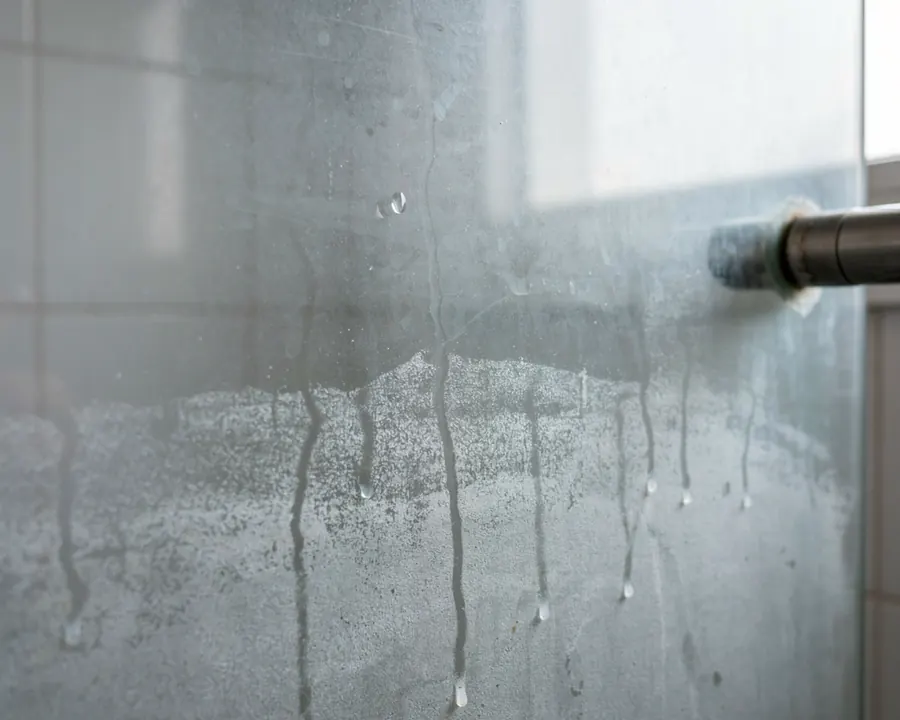
- 2The shower glass. Spots returning straight after cleaning means hard water.
- 3Soap. Poor lather and a film on the skin means hard water.
Three yeses and you do not need a laboratory.
What helps, honestly
Hardness itself is changed only by a water softener, which is plumbed into the incoming supply and costs an order of magnitude more than anything on this site.
A shower filter does something different: it reduces chlorine and catches sediment from the pipes. It screws on by hand in under a minute. If what bothers you is how your skin and hair feel after a shower, that is the cheap first step. If what bothers you is limescale on the glass, it is not.
Hana reduces chlorine and sediment, carries vitamin C, and leaves a scent you choose. Eight scents, delivered across Serbia.
See the shopFrequently asked questions
Is Belgrade tap water safe to drink?
Yes. The City Institute of Public Health analyses the system daily and reports it as compliant. This article is about how the water behaves on skin and hair, which is a different question from safety.
How hard is Belgrade water?
Around 14 German degrees on average, which is above the hard water threshold of twelve. It ranges from about nine in southern districts to eighteen on New Belgrade and Zemun, according to the water utility.
Does a shower filter soften water?
No. It reduces chlorine and catches sediment. Hardness is changed only by a water softener, a separate device plumbed into the incoming supply.
Read next
 5 September 2026 · 4 minBelgrade water is safe to drink. That is not the same as kind to your skin.Two different questions that keep getting answered as one. The city guarantees the first. Nobody has looked at the second.
 5 September 2026 · 5 minDo scented shower filters actually work?The whole category sells on what a filter removes. Almost nobody has written about the part you can actually smell.
 5 September 2026 · 4 minHow long does the scent from a shower filter actually last?On your skin, in your hair and in the bathroom, these are three different answers. Here are all three without the marketing.